The Color of Happiness: How Eating the Rainbow Benefits Your Mood
20 September 2026
Most people treat food as fuel or as a pleasure, and stop there. They count calories, watch macros, or chase whatever diet is trending, without ever asking a more interesting question: why does a plate of dull beige food leave you feeling flat, while a plate full of red, orange, green, and purple makes you feel lighter before you have even taken a bite?
The answer sits at the intersection of nutrition science, neuroscience, and plain common sense. The pigments that give plants their colors are not decoration. They are biologically active compounds that influence inflammation, neurotransmitter production, blood sugar stability, and even the bacteria living in your gut. All of those systems feed directly into your mood, energy, and mental clarity.
This article is not going to tell you that eating a salad will cure depression. That would be dishonest. What it will do is explain, in practical terms, how the colors on your plate connect to the way you feel, where the real mechanisms live, and how to build a way of eating that supports your mood without turning dinner into a chemistry experiment.
Why Color Is a Signal, Not a Gimmick
When nutritionists say "eat the rainbow," they are using color as shorthand for something specific: different plant pigments come bundled with different families of phytonutrients. Each family tends to concentrate in particular tissues and perform particular jobs in the plant. Those same compounds, when they reach your body, interact with your biology in overlapping but distinct ways.Here is the key idea that most articles skip. Color is not the active ingredient. Color is a marker. It tells you which class of compounds you are likely getting.
- Red and pink plants often carry lycopene and anthocyanins.
- Orange and yellow plants tend to be rich in carotenoids such as beta-carotene and lutein.
- Green plants deliver chlorophyll, folate, and a range of glucosinolates in the cruciferous family.
- Blue and purple plants are dense in anthocyanins and resveratrol-like compounds.
- White and tan plants, which people often dismiss as colorless, contain allicin, quercetin, and other compounds worth having.
If you eat only greens, you are not eating "healthy" in a complete sense. You are eating one chapter of a longer book. This is one of the most common mistakes I see, and it is worth stating plainly: a diet of nothing but spinach, kale, and broccoli is not a rainbow. It is a monochrome with good PR.
The Gut-Brain Axis: Where Mood Actually Begins
To understand why plants affect mood, you have to start in the gut, because that is where a surprising amount of the action happens.Your digestive tract houses trillions of microorganisms. Collectively they are called the gut microbiota. These microbes ferment fiber and phytonutrients that your own enzymes cannot break down, and in the process they produce short-chain fatty acids such as butyrate, acetate, and propionate. Those fatty acids do more than feed your intestinal cells. They influence the integrity of your gut lining, the behavior of your immune system, and the signals that travel along the vagus nerve to your brain.
Here is why color matters in this context. Different fibers and phytonutrients feed different microbial populations. A diverse diet produces a diverse microbiome. A narrow diet produces a narrow one. And a narrow microbiome tends to be less resilient, meaning it bounces back more slowly from stress, antibiotics, illness, or a stretch of poor eating.
The practical implication is straightforward. If you want a microbiome that supports stable mood, you need variety, and variety in plants almost always shows up as variety in color. Eating the rainbow is, in effect, a simple visual proxy for feeding a wide range of microbes.
There is a second layer here that is easy to overlook. Roughly a large share of the body's serotonin, a neurotransmitter heavily involved in mood regulation, is produced in the gut. That does not mean gut serotonin directly controls how happy you feel. It does not cross into the brain in meaningful amounts. But the gut environment influences the signals that do reach the brain, including immune messages and vagal signals. So gut health and mood are connected, even if the pathway is more indirect than headlines suggest.
The Inflammation Connection
Chronic low-grade inflammation is one of the more credible bridges between diet and mood. When the immune system stays mildly activated for months or years, it can affect brain function, energy levels, and the way you handle stress.Many plant pigments have anti-inflammatory and antioxidant activity. Anthocyanins in berries, curcumin-related compounds in turmeric, sulforaphane precursors in broccoli and other cruciferous vegetables, and polyphenols in green tea all interact with inflammatory pathways in ways researchers continue to study. The effects are usually modest when you look at any single meal. They become meaningful when they accumulate over years.
This is where people often go wrong. They read that berries are anti-inflammatory, eat a handful once, and expect to feel different by evening. That is not how it works. The benefit is a long game, built on consistent intake across many plant types, not a single heroic serving.
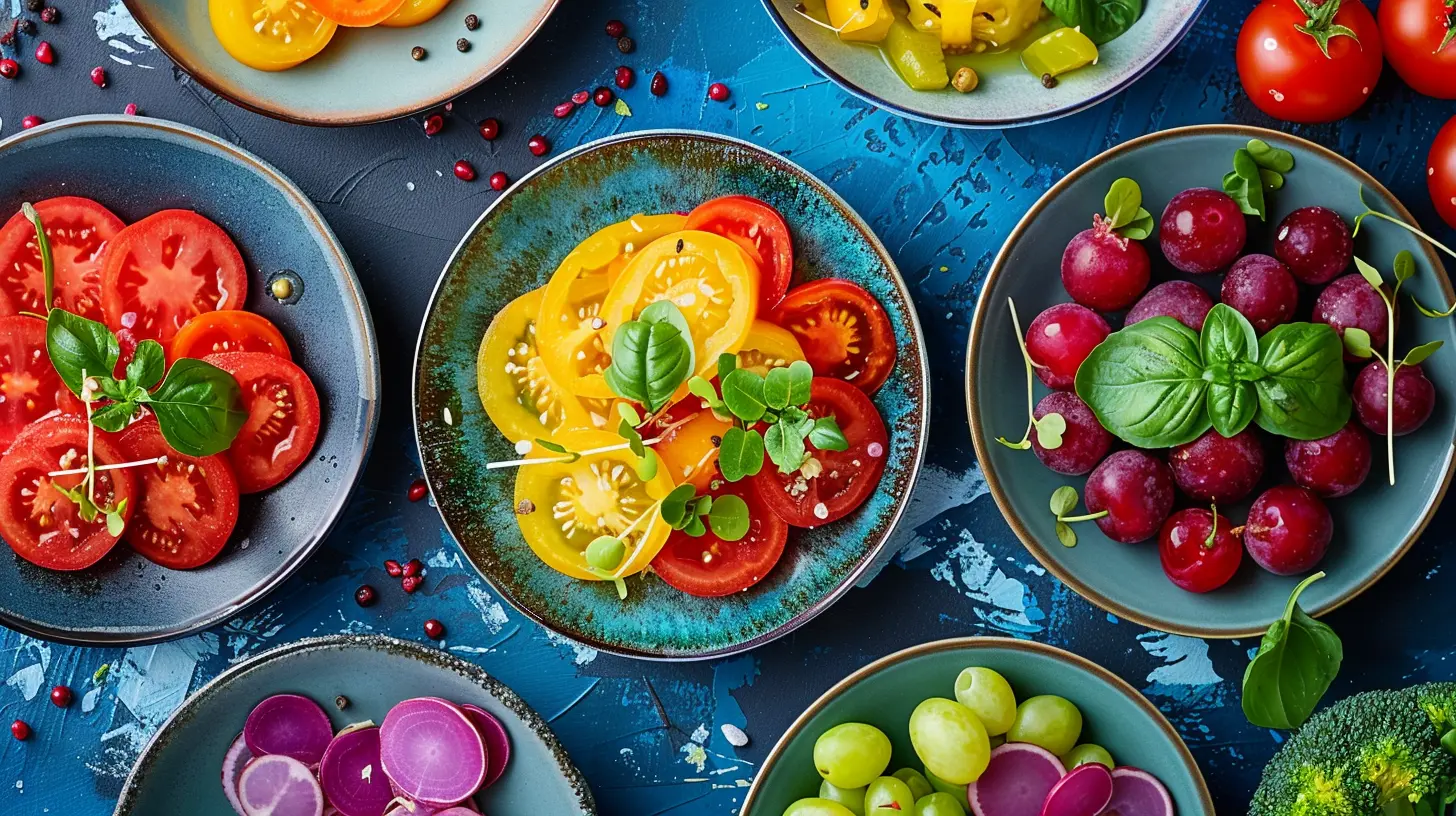
A Color-by-Color Breakdown That Goes Beyond the Basics
Let us walk through the main color groups, but with attention to what actually matters: what the compounds do, when they help most, and where the hype outruns the evidence.Red: Lycopene, Anthocyanins, and Heart-Friendly Compounds
Red foods include tomatoes, watermelon, red peppers, strawberries, raspberries, pomegranates, and red beans.Tomatoes are the best-known source of lycopene. Cooking tomatoes with a little fat increases lycopene absorption, which is why tomato sauce and tomato paste deliver more than raw tomatoes in some respects. This is a useful trade-off to understand: raw tomatoes give you more vitamin C and water content, while cooked tomatoes give you more bioavailable lycopene. Both are worth eating.
Berries in this group provide anthocyanins and vitamin C. They are also relatively low in sugar compared to many fruits, which matters if you are sensitive to blood sugar swings. Blood sugar instability is one of the most underrated contributors to mood crashes, and I will return to it shortly.
Practical note: frozen berries are often as nutritious as fresh ones and considerably cheaper. There is no shame in using them.
Orange and Yellow: Carotenoids and Vision, Skin, and Immune Support
This group includes carrots, sweet potatoes, squash, pumpkin, oranges, mangoes, apricots, and yellow peppers.Beta-carotene is the headline compound, and your body converts it into vitamin A as needed. This is a self-regulating system, which is why eating carrots will not give you vitamin A toxicity, though it can temporarily tint your skin orange if you eat extreme amounts. That condition is harmless and reversible.
Lutein and zeaxanthin, found in yellow and orange plants as well as leafy greens, concentrate in the retina and are associated with eye health. The mood connection here is indirect but real: poor vision and eye strain affect quality of life, sleep, and stress levels.
One caution worth stating. Beta-carotene supplements have been linked in some studies to increased risk in certain high-risk groups, particularly smokers. Food sources do not carry the same concern. This is a good example of why whole foods and isolated supplements are not interchangeable.
Green: Folate, Chlorophyll, and Cruciferous Compounds
Greens deserve their reputation, but for reasons people often misstate. The most mood-relevant nutrient in greens is folate, a B vitamin involved in neurotransmitter synthesis and methylation, a process that affects how genes are expressed and how the brain manages chemical signaling.Low folate status has been associated with depressed mood in observational research. Whether correcting a deficiency improves mood depends on the person, but it is reasonable to ensure adequate intake. Leafy greens, asparagus, Brussels sprouts, and broccoli are solid sources.
Cruciferous vegetables also contain glucosinolates, which convert into compounds like sulforaphane when the plant is chopped or chewed. Sulforaphane activates what is called the Nrf2 pathway, part of the body's own antioxidant defense system. This is genuinely interesting science, but be careful with claims that it "detoxifies" you. The body already detoxifies itself. These compounds support that system rather than replacing it.
A practical tip: chopping broccoli and letting it rest for a few minutes before cooking can help preserve some of the enzyme activity that produces sulforaphane. It is a small habit with a plausible benefit.
Blue and Purple: Anthocyanins and Cognitive Support
Blueberries, blackberries, purple cabbage, eggplant, plums, grapes, and purple potatoes belong here.Anthocyanins give these foods their deep color and are among the most studied polyphenols for brain health. Some research suggests they support blood flow to the brain and may have neuroprotective properties. The evidence is promising but not definitive. Treat it as a reason to include these foods regularly, not as a guarantee of sharper memory.
Purple potatoes and purple carrots are worth mentioning because they offer the anthocyanins of berries with the fiber and satiety of a starch. If you find berries expensive, these are a budget-friendly alternative.
White and Tan: The Overlooked Category
Garlic, onions, leeks, cauliflower, mushrooms, parsnips, and white beans live here.These foods contain compounds like allicin, quercetin, and beta-glucans. They also tend to be good sources of prebiotic fiber, which feeds beneficial gut bacteria. People chasing colorful plates often skip them, which is a mistake. A rainbow without white is incomplete.
Mushrooms deserve a special mention. They are one of the few non-animal food sources of vitamin D when exposed to ultraviolet light, and vitamin D status has been linked to mood in a number of studies. The relationship is complex and supplementation does not reliably improve mood in people who are not deficient, but food sources are a sensible baseline.
Blood Sugar: The Mood Lever Nobody Talks About Enough
Here is where I want to push back on the rainbow narrative in a useful way. Colorful food is not automatically mood-friendly. A plate of candy is colorful. So is a bowl of fruit loops. Color only predicts benefit when the underlying food is also supportive of stable blood sugar and overall nutrition.Blood sugar swings are one of the most direct dietary influences on how you feel hour to hour. A rapid spike followed by a crash can produce irritability, fatigue, anxiety, and cravings. This is not speculation; it is something many people experience directly after a high-sugar meal.
Plant foods affect blood sugar differently depending on their fiber content, their form, and what you eat them with. Whole fruit behaves very differently from fruit juice. Beans and lentils behave very differently from white bread. The color of a food tells you about its phytonutrients, not about its glycemic impact. You need both pieces of information.
The practical takeaway: pair colorful plants with protein, fat, and fiber to smooth the blood sugar curve. A bowl of berries alone is fine. A bowl of berries with Greek yogurt and nuts is better for sustained mood.
Where Eating the Rainbow Fits and Where It Does Not
I want to be honest about the limits of this approach, because overselling it helps no one.Eating a diverse, plant-rich diet is associated with better mental health in many observational studies. But association is not causation. People who eat more plants also tend to exercise more, sleep better, smoke less, and have more social support. Untangling those factors is genuinely difficult.
What we can say with confidence is this:
- A varied plant-rich diet supports gut health, which supports overall wellbeing.
- It reduces the risk of chronic diseases that themselves affect mood, such as cardiovascular disease and type 2 diabetes.
- It provides the raw materials your body needs to produce and regulate neurotransmitters.
- It stabilizes energy, which stabilizes mood.
What we cannot say is that eating kale will treat clinical depression. If you are experiencing persistent low mood, loss of interest, or thoughts of self-harm, that is a medical situation. Food is a supporting player, not a substitute for professional care. Please take that seriously.
Common Mistakes and Misconceptions
Let me list the traps I see most often, because avoiding them is worth more than memorizing nutrient tables.Mistake one: chasing exotic superfoods. Goji berries and acai are fine, but they are not magic. Ordinary blueberries, cabbage, and carrots do much of the same work at a fraction of the cost. Food marketing thrives on novelty, not necessity.
Mistake two: juicing instead of eating. Juicing strips out fiber and concentrates sugar. You lose the slow-release benefit that makes whole plants so useful for mood and blood sugar. A smoothie is better than juice because it keeps the fiber, but whole fruit is better still.
Mistake three: counting colors instead of eating plants. Five colors from five processed snacks is not the goal. The goal is whole or minimally processed plants.
Mistake four: ignoring preparation. Boiling vegetables for a long time leaches water-soluble vitamins into the water. Steaming, roasting, and stir-frying generally preserve more. That said, some nutrients, like lycopene, become more available with cooking. There is no single best method, only trade-offs.
Misconception: more color always means more nutrients. Some deeply colored foods are less nutritious than paler ones. Cauliflower is white and excellent. Iceberg lettuce is green and mostly water. Color is a useful heuristic, not a law.
How to Actually Build a Rainbow Plate
Enough theory. Here is how to put this into practice without overhauling your entire life.Start With What You Already Eat
Do not throw out your current diet. Add to it. If you eat eggs and toast, add spinach and tomato. If you eat rice and chicken, add roasted peppers and broccoli. Small additions compound.Aim for Three Colors Per Meal, Five Per Day
This is a realistic target. Three colors at a meal is achievable even on busy days. Five across a day covers most nutrient families.Use Frozen and Canned Wisely
Frozen vegetables are picked and frozen at peak ripeness and often retain nutrients well. Canned tomatoes, beans, and pumpkin are convenient and affordable. Watch for added sodium and sugar, and rinse canned beans if sodium is a concern.Keep a Few Convenient Options on Hand
Pre-washed greens, frozen berries, bagged slaw mix, and pre-cut vegetables reduce friction. Convenience is not laziness. It is strategy.Think in Categories, Not Individual Foods
Instead of memorizing nutrients, remember the groups: leafy greens, cruciferous, berries, citrus, alliums, root vegetables, legumes, and mushrooms. Rotate through the groups across the week.Add Fat to Fat-Soluble Compounds
Carotenoids are fat-soluble. A little olive oil, avocado, or nuts with your carrots and tomatoes improves absorption. This is a small change with a real effect.A Sample Day That Puts It Together
Breakfast: plain yogurt with frozen berries, ground flax, and walnuts. Colors: red, purple, tan.Lunch: grain bowl with quinoa, roasted red peppers, chickpeas, spinach, and a lemon tahini dressing. Colors: red, green, tan.
Snack: an orange and a small handful of almonds. Colors: orange, tan.
Dinner: baked salmon with roasted sweet potato, broccoli, and garlic sauteed mushrooms. Colors: orange, green, white.
That is six or seven colors across the day, with protein, fat, and fiber at every meal. Nothing exotic. Nothing expensive. No powders or supplements required.
What About Supplements?
This is a fair question, and the honest answer is nuanced.If you have a diagnosed deficiency, such as low vitamin D or low B12, supplementation is appropriate and often necessary. Work with a clinician.
If you are simply looking to support mood through plant compounds, food is generally the better route. Whole foods contain hundreds of compounds that interact in ways we do not fully understand. Isolating one and putting it in a capsule rarely reproduces the full effect. In some cases, as with beta-carotene in smokers, isolated supplements have caused harm.
There is one exception worth naming. Omega-3 fatty acids, particularly EPA, have some evidence for mood support in specific contexts. But that is a fat, not a pigment, and it belongs to a different conversation.
The Bottom Line
The color of happiness is not a metaphor. It is a practical signal that your plate contains a wide range of compounds your body uses to regulate inflammation, feed your gut bacteria, stabilize energy, and support the chemistry underlying mood.None of this works overnight. It works across weeks, months, and years, through consistent small choices. It works best when it is paired with sleep, movement, sunlight, and human connection, because mood is never the product of a single input.
So the next time you build a meal, glance at the plate. If it is all one color, add another. If it is all beige, add something green, red, or purple. That small act, repeated often, is one of the more reliable things you can do for the way you feel.
all images in this post were generated using AI tools
Category:
Mood Boosting FoodsAuthor:

Jackson Mahoney